
'Common sense says if one can afford, servicing the loans during this period is a better bet than postponing it by three months,' says Tamal Bandyopadhyay.

Exporters on Thursday demanded fiscal incentives, tweaking in customs duties on certain products and credit at affordable rates in the forthcoming Budget to boost exports and create jobs. In a pre-budget virtual meeting with Finance Minister Nirmala Sitharaman, the Federation of Indian Export Organisations (FIEO) said the depreciation of the rupee against the US dollar is affecting exports' competitiveness and the sector requires more support. "Creation of employment is the biggest challenge faced by the country...We would urge the government to provide fiscal support to units which provide additional employment in the export sector," the exporter's body said.

The pandemic has led to the International Finance Corporation massively ramping up its impact investment in the country - its largest client nation globally - at $1.7 billion as of June, a 51 per cent rise over the past 12 months, the largest developmental lender into third world private sector said on Tuesday. This is nearly half of its investment in the whole of South Asia since the pandemic, which touched $3.8 billion as of June 2021, it said. "Our total commitment to India, which is our largest client country globally, at the end of June stood at $1.7 billion representing an increase of over 51 per cent from last year," IFC vice-president for Asia and the Pacific region Alfonso Garcia Mora said in a statement.

The government has no plan to print currency notes to tide over the current economic crisis triggered by the outbreak of COVID-19 pandemic, Finance Minister Nirmala Sitharaman informed Parliament on Monday. To a question on whether there is any plan to print currency to tide over the crisis, the finance minister said, "No Sir". Many economists and experts have suggested to the government to print more currency notes to tide over the difficult economic situation with a view to support the economy ravaged by the spread of COVID-19, and protect jobs.

'Till now, we were under tremendous stress. The economy was not recovering, the financial cycle was not moving and the banks were not supporting.' 'With the government pumping in money to the banks and asking the NBFCs to give priority to the MSME sector, there will be a revival.'

There are loans to salaried people where the borrower is employed, but has failed to make repayment. Such loans would be identified and sold in a pool to ARCs.

Finance Minister Nirmala Sitharaman presents her fourth Budget in Lok Sabha on Tuesday.

he feels they are prone to misuse by borrowers, including farmers, and suggested a rate ceiling for loans by micro finance lenders.

According to highly placed sources, the finance ministry is likely to extend ECLGS and other loan guarantee schemes for micro, small and medium enterprises (MSMEs), hospitality and tourism sector, and the health infrastructure beyond March 31, Business Standard has learnt. This is likely to be announced by Finance Minister Nirmala Sitharaman as part of her Budget speech on February 1.
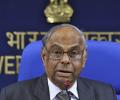
It is time for the three finance ministers of the 1990s to reveal the real hero, says T C A Srinavasa-Raghavan.

Reserve Bank of India Governor Shaktikanta Das on Friday said the central bank will ensure adequate liquidity in the system to ease the financial stress caused by the Covid-19 pandemic. The central bank reduced the reverse repo rate -- the rate at which banks park their fund with the central bank -- by 25 basis points to 3.75 per cent.

For the first time in our economic history a government has thought about more than 50 per cent of our economic activity instead of the five per cent represented by the Sensex companies, observes IIM-B professor R Vaidyanathan.

Small and medium enterprises have been struggling to raise bank credit even as they have been powering India's manufacturing growth in recent years.

Their number is dwindling, but single-screens believe they have a place in the entertainment space

Moody's said implementation challenges, in addition to affecting growth and government revenues, will impact corporates by lowering sales volumes and cash flows.

'The solution is to enable a graceful transfer of the deposit and funding 'franchise' from capital-deficient firms to capital-surplus firms.' 'This will expand credit intermediation, bring down its costs, and put the financial sector on a definite path of recovery,' argues former RBI deputy governor Viral Acharya.
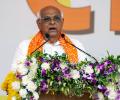
Patel was administered the oath as the 18th chief minister by Governor Acharya Devvrat at a function held at the Helipad Ground near the new Secretariat.

Rather than talking endlessly about lost and marginal opportunities, India's climate envoys need to start thinking bigger, says Mihir S Sharma.

Banks will also consider requests from MSMEs for restructuring their stressed standard assets. So far, only 25 per cent of the around 1 million eligible MSMEs have taken benefit of the RBI's special dispensation.

Bandhan Bank is expecting that a little less than 50 per cent of its portfolio will be dominated by affordable housing loans in the next three to five years.

Of the 2,562 customer complaints received between January 2020 and March 2021, a majority relate to illegal apps. At least two dozen suicide cases have been reported, perpetrated by the harassment by loan app operators, points out Tamal Bandyopadhyay.

New players show up after 3 years; northern states take lead in loan growth.

One of Mumbai's biggest real estate redevelopment projects of Bombay Development Directorate's (BDD's) chawls (large buildings divided into many separate tenements, offering cheap, basic accommodation) has taken off in Central Mumbai, opening up a Rs 20,000-crore opportunity for real estate companies. It is expected to drive down real estate prices in Central Mumbai by up to 25 per cent, forecast real estate experts. Spread over 92 acres in Central Mumbai's prime localities of Worli, Lower Parel, and Dadar and consisting 195 four-storey houses, the BDD chawls were constructed in the 1920s.

The insurance regulator wants the removal of the minimum entry capital requirement of Rs 100 crore for setting up an insurance business in a bid to facilitate the entry of multiple players such as standalone micro insurers and niche players. Debasish Panda, chairman, Insurance Regulatory and Development Authority of India (Irdai), said it should be left to the regulator instead to decide what should be the entry fee for interested players, depending on the size of the business and operations. According to the current norms, insurers are required to have a minimum paid-up capital of Rs 100 crore.

Pulbic banks have no reason to cheer Budget announcement.

While the meetings on Friday were preliminary discussions, it is learnt that sectors like tourism; hospitality; aviation; micro, small and medium enterprises (MSMEs); and livestock have sought deferring loan repayments and temporary tax holidays in specific cases to help them tide over the steep fall in economic activity.

A bunch of CEOs in their mid-30s and early 40s are trying to rectify the scenario where shady lending applications trap hapless borrowers with astronomically high interest rates and even bodily harm if the money was repaid. Anup Roy reports.

While the total disbursement of housing loans by PSBs as well as HFCs witnessed a deceleration in 2016-17, there was significant growth for the lower slabs

After the Gujarat and Himachal elections and the municipal polls in Mumbai and Delhi, Karnataka, Rajasthan, MP and Chhattisgarh will elect new assemblies next year leading up to the Lok Sabha election in April-May 2024, points out Virendra Kapoor.

The ministry also decided to dispense with the requirement of the Integrity Pact Bank Guarantee to reduce the financial burden on the Indian defence industry, a move aimed at promoting domestic manufacturing.

The Reserve Bank on Wednesday said it plans to issue new bank licences around January, "consistent with the highest standards of transparency and diligence."

S&P Global Ratings on Wednesday said Indian banks face a systemic risk as the second COVID wave will impair the performance of financial institutions in the April-September period. Stating that economic recovery remains highly vulnerable to setbacks due to COVID, particularly if fresh outbreaks trigger new lockdowns, S&P said the banking sector's weak loans will likely remain elevated at 11-12 per cent of gross loans in the next 12 to 18 months. "The second wave has front-ended weakness in asset quality," said S&P Global Ratings Credit Analyst Deepali Seth Chhabria. "Financial institutions face a strained first half amid weak collections and poor disbursements."

'The recent US jobs report has eased fears of a hike in the Fed meeting.'

For Duflo and Banerjee, an important part of their work has been ensuring that the agency of the "beneficiaries" -- usually, in developing countries like India, poorer individuals -- is put at the centre of any policy design. This is a crucial way in which experimental results are often better than large scale data-based inference, says Mihir S Sharma.

A paper authored by Rajan said, state-linked banks can be a first step in altering the ownership structure of some PSBs, where the government brings down its stakes to below 50 per cent, creating distance from operations of banks, and improving governance along the way.

Macroeconomic management is usually a lot more comfortable with lower fiscal deficits. The sooner we get there, the better for the economy, says former Chief Economic Adviser to the Government of India Shankar Acharya.
The main reason was that CPI inflation would likely remain below 4 per cent till July.

Bandhan Bank to fund SMEs, create jobs, says FM

Finance Minister Nirmala Sitharaman on Monday said the government is planning to extend the suspension of fresh insolvency proceedings for another three months, a move which will provide major relief to corporate borrowers hit by the coronavirus pandemic. Addressing the Bangalore Chamber Of Industry And Commerce (BCIC), she said the government has taken several measures, including deferment of tax payment date, to help businesses and people.

Banks have started refunding borrowers the compound interest charged on specified loan accounts during the moratorium period. Last week, the Reserve Bank of India (RBI) had asked all lending institutions, including non-banking financial companies, to ensure that the scheme of waiver of interest on interest for loans up to Rs 2 crore for the six-month moratorium period is implemented by November 5.
 © 2026 Rediff.com - Advertise with us - Disclaimer - Privacy Policy - Sitemap - Feedback - About us - Terms of use - Grievances